What exactly is a digital guest directory? If you run a hotel and this term keeps popping up in your research or vendor conversations, here’s a straightforward explanation without unnecessary jargon.
In a nutshell: a digital guest directory replaces the paper binder sitting on the nightstand. Your guests access hotel information from their smartphone via a QR code or short URL. No app to download, no complicated setup.
Simple definition of a digital guest directory
A digital guest directory—also called a digital room directory, guest app, or digital compendium—is a web-based application that centralizes all your property’s practical information. Guests access it instantly from their own phone.
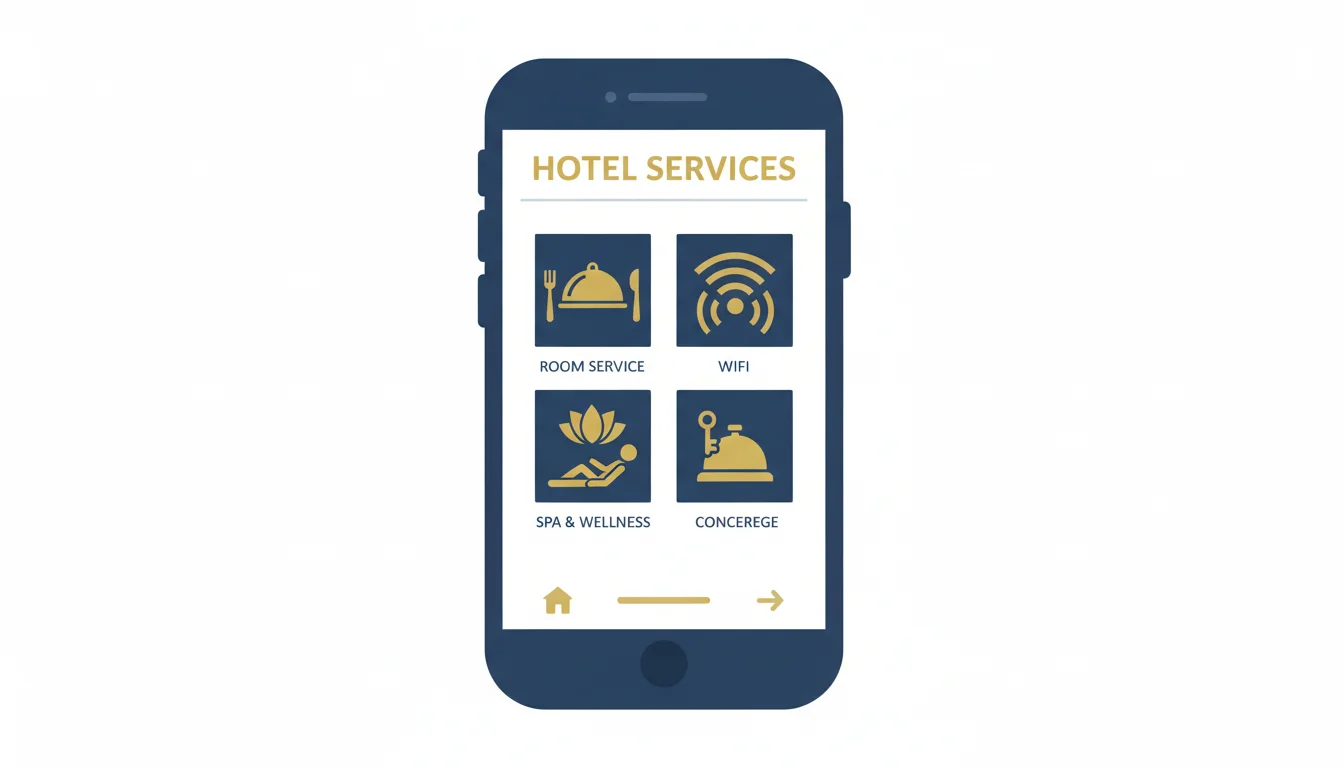
In practice, it looks like a mobile app with menus, buttons, and images. Except guests don’t install anything. They scan a code, and everything appears: breakfast hours, WiFi password, room service menu, front desk number, local recommendations.
What a digital guest directory typically includes
Content varies by property, but you’ll generally find:
Essential info — WiFi code, service hours (restaurant, pool, spa, fitness), front desk and room service contacts, how-to guides for room equipment (AC, safe, TV).
Bookable services — Room service menu with direct ordering, spa treatments with online booking, on-demand services (laundry, airport transfer, late checkout).
Local content — Restaurant recommendations, things to do, transportation info, useful numbers (24-hour pharmacy, emergencies).
Digital guest directory vs paper compendium: key differences
Paper informs. Digital informs AND enables action. That’s the fundamental difference.
With a paper binder, guests read the spa hours. With a digital directory, they read the hours, see availability, and book their treatment. In thirty seconds, from their bed.
Real-time updates
Your chef changes the daily special? You update it in the back-office, it appears immediately on every guest’s phone. With paper, you print inserts, distribute them to 80 rooms, and hope housekeeping remembers to remove the old ones.
Native multilingual support
The Japanese guest arriving at your Manhattan hotel selects their language, everything displays in Japanese. No need to maintain fifteen paper versions or manage language tabs.
Data and analytics
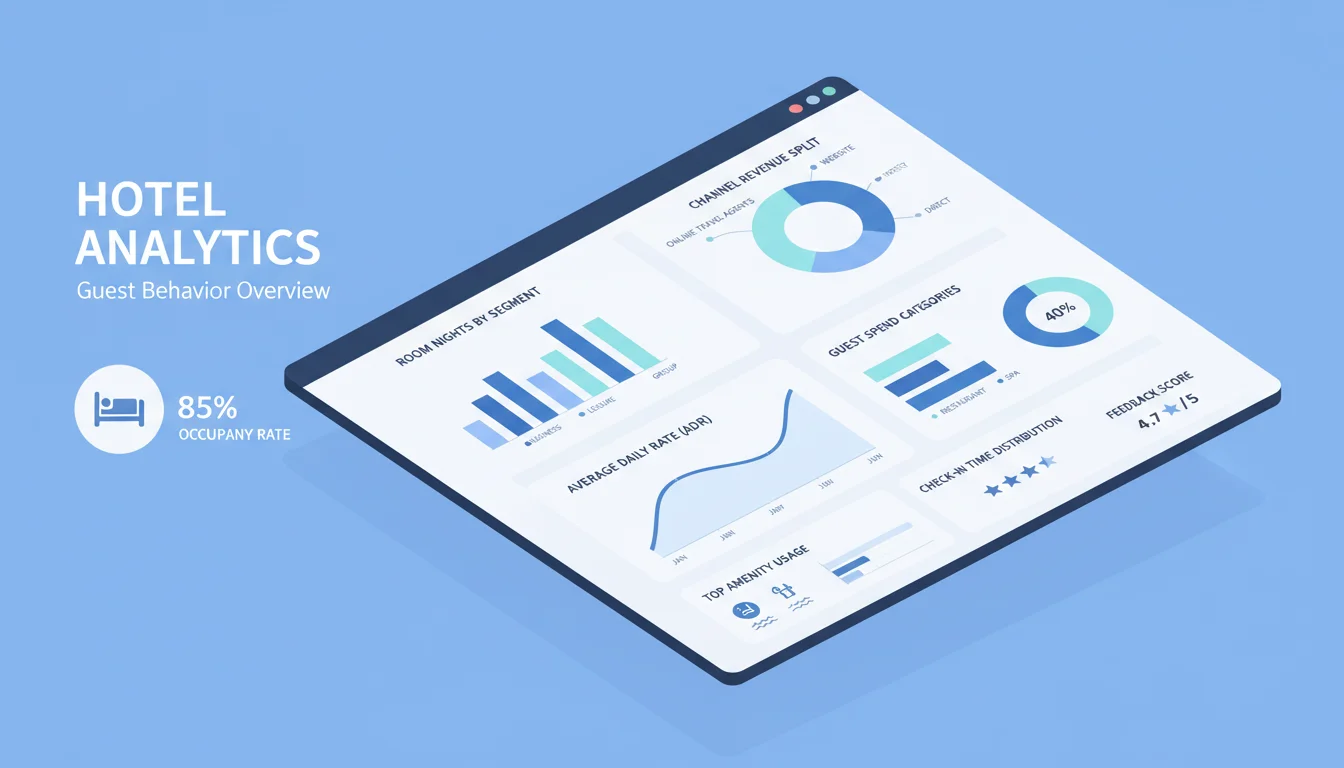
You finally know what interests your guests. Which pages do they view? When do they order room service? How many look at the spa menu without booking? This data drives your commercial decisions.
Hygiene and perception
Since 2020, guests pay attention to what they touch. A binder handled by dozens of people before them? That’s a silent irritant. Their own phone? That’s their comfort zone.
Concrete benefits for your hotel
Beyond the obvious modernization, a digital guest directory generates measurable results.
Fewer front desk calls
Questions like “when’s breakfast?”, “what’s the WiFi password?”, “how does the AC work?” find answers in the directory. Hoteliers report a 25-40% drop in incoming calls. Your team focuses on high-value requests instead of repetitive answers.
More orders, more revenue
When ordering a club sandwich at 11 PM takes thirty seconds on a phone (instead of finding the number, calling, waiting), orders increase. Same logic for spa, minibar, parking. Some properties report a 30-50% boost in ancillary sales.
Better guest experience
An autonomous guest is a satisfied guest. They find what they’re looking for effortlessly, order when they want, feel in control of their stay. That translates to online reviews.
Modern, professional image
For a 4 or 5-star hotel, a digital guest directory isn’t a bonus anymore. It’s expected. Its absence can surprise guests accustomed to digital in every aspect of their lives.
How it works technically
You don’t need to be a developer to understand. The principle is simple.
Guest side
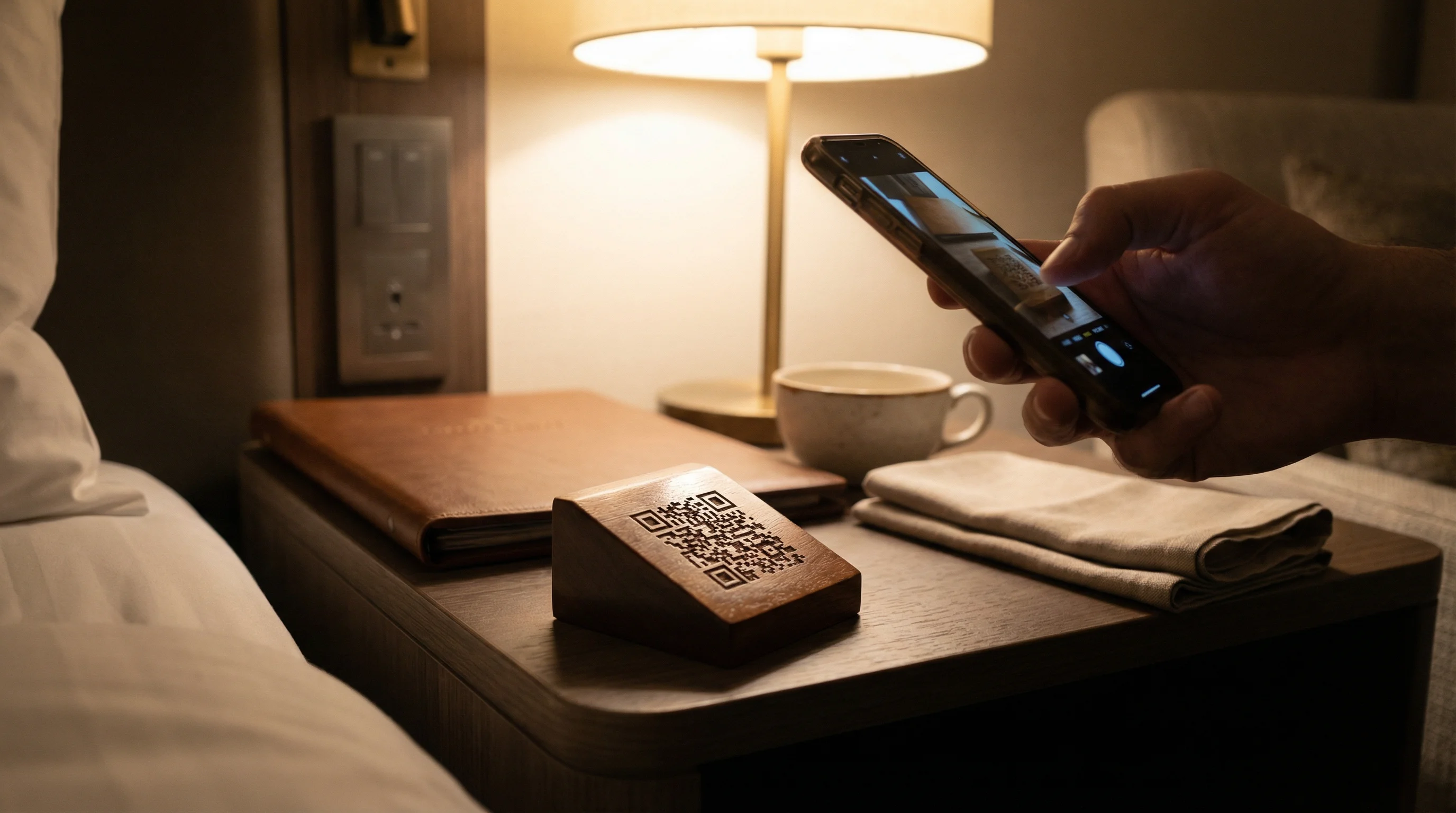
Guests scan a QR code placed in the room (nightstand, welcome card, bathroom mirror). Their browser opens a mobile-optimized web page. They browse, view, order. Nothing to download, nothing to configure.
Hotel side
You access an admin interface (back-office) where you manage all content: text, images, hours, prices, menus. Changes are instant. You can also view usage statistics and orders placed.
Infrastructure
The solution is typically cloud-hosted by the provider. You don’t install anything on your servers. A monthly subscription covers hosting, updates, and usually support.
Who is a digital guest directory for?
Technically, any property can benefit. In practice, ROI is clearer for certain profiles.
4 and 5-star hotels
Guests expect a digital service level consistent with the property’s standing. The guest directory becomes a standard, not a luxury.
Properties with strong international clientele
The more nationalities you welcome, the more native multilingual support matters. A hotel in New York or Miami with 70% foreign guests sees immediate returns from this feature.
Hotels with developed ancillary services
If you have a spa, fine dining restaurant, or experiences to sell, the digital directory becomes an additional sales channel. The investment pays back through generated ancillary revenue.
Independents who want to differentiate
Against chains that standardize experiences, a digital guest directory lets independents offer modern, personalized service that reflects their identity.
What a digital guest directory is NOT
A few clarifications to avoid misunderstandings.
It’s not an app to download. Guests don’t install anything on their phone. It’s a webapp accessible via browser.
It’s not a PDF on a tablet. A PDF stays static, non-interactive, frozen. A digital guest directory is living, clickable, orderable.
It’s not a replacement for your team. It’s a complement. Basic requests go self-service; your staff focuses on relationships and complex requests.
It’s not just for big chains. Current solutions are accessible to independents, with adapted pricing and simple interfaces to manage.
Next step
If this concept interests you, our complete guide to digital guest directories details implementation, solution selection criteria, and best practices to maximize guest adoption.
You can also request a demo to see what it would look like with your property’s visual identity.